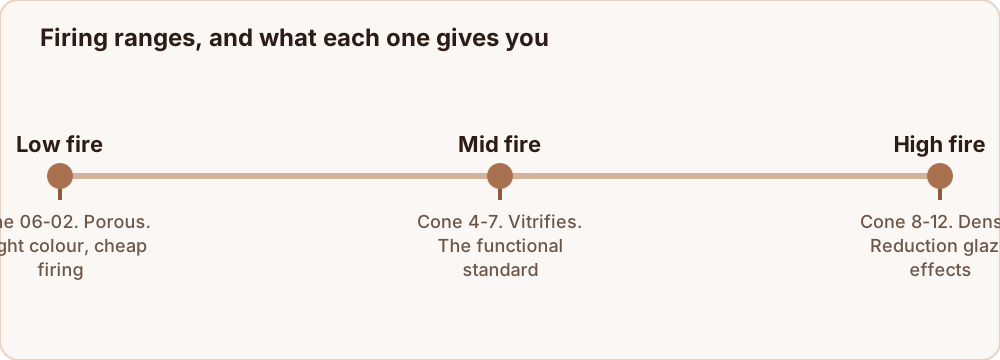
Low fire clay is any clay body that reaches maturity at roughly cone 06 to cone 02 — about 1000 to 1100 °C. Terracotta is the familiar red version; white earthenware is the base of most commercially produced dinnerware, and of nearly every piece of decorated ware in a school art room.
The defining characteristic is not the temperature itself but what happens at it: low fire bodies never fully vitrify. Enough glass forms between the particles to make the pot hard and permanent, but not enough to close the pores.
From the studio: I made a set of terracotta planters and left them outside through a hard winter, and by spring three of them had split along visible lines. Water had soaked into the porous body, frozen, and pushed the walls apart. Nothing was wrong with how I made them. I had simply used a porous body somewhere it would freeze wet.
What porosity actually means
A fired low fire body typically absorbs 5 to 15 percent of its weight in water. Stoneware fired to maturity absorbs under 1 to 2 percent.
That difference has practical consequences:
- Water gets in. Any chip, crack, unglazed foot or crazed glaze lets liquid into the body, where it can seep, stain and harbour bacteria.
- Freeze-thaw destroys it. Water inside a porous wall expands when it freezes. This is why unglazed terracotta planters crack outdoors in cold climates.
- The glaze does all the work. On low fire ware, the glaze is not decoration with a waterproofing side effect; it is the only barrier there is.
- Crazing matters more. On stoneware, a crazed glaze is unattractive. On earthenware, it is a genuine functional failure.
What you get in return
Low fire is not a lesser option, it is a different set of trade-offs, and for some work it is clearly the right one.
Colour. This is the real reason. Many ceramic stains and underglazes burn out or shift above cone 6 — bright reds, oranges, hot pinks, purples and clear yellows are far more reliable at low temperature. The vivid majolica tradition, and most brightly decorated commercial tableware, exists at low fire for exactly this reason.
Cost. Less time above 1000 °C means less electricity and much longer element life. For a school firing weekly, the difference over a year is substantial.
Equipment. Almost any kiln, including small hobby kilns that plug into a standard socket, will reach cone 04.
Speed. Lower peak temperature means shorter firings and faster cooling.
Which clay ceramics actually use
If the question is what a working potter uses, the honest answer is that the field has largely moved to the middle:
| Body | Cone | Typical use |
|---|---|---|
| Earthenware / terracotta | 06–02 | Decorative work, planters, majolica, schools |
| Mid-fire stoneware | 5–7 | The functional default: mugs, bowls, plates |
| High-fire stoneware | 9–10 | Gas reduction work, traditional studio pottery |
| Porcelain | 6–13 | White, translucent, fine work |
For anything that holds food or drink daily, mid-fire stoneware is the pragmatic choice, and cone 6 vs cone 10 covers why cone 6 in particular has become the standard.
The mistake to avoid
Never fire a low fire body above its range. A cone 04 earthenware taken to cone 6 does not become stronger — it bloats, slumps, and can weld itself permanently to your kiln shelf. The fluxes that let it mature at low temperature keep working as the temperature rises, and the body eventually turns into something closer to a glaze.
The reverse is equally unhelpful. A cone 10 stoneware fired at cone 04 comes out chalky, weak and thoroughly porous, because it never got close to maturity.
The rule is simple: match the body, the glaze and the firing to the same cone. This is the first question to ask a supplier, and where to buy clay for pottery covers the rest of the conversation.
Testing what you actually have
If you have a bag of unlabelled clay, or clay you dug yourself, one test tells you nearly everything:
- Fire a small tile at your intended cone.
- Weigh it dry.
- Boil it in water for two hours, then leave it submerged overnight to cool.
- Dry the surface and weigh it again.
The percentage gain is the absorption. Under 1 percent means fully vitrified. Around 3 percent is usable for most functional work. Over 5 percent and you have a low fire body, whatever the temperature said on the shelf.
Where low fire is the right answer
It is worth being specific, because "use stoneware" is over-applied advice.
Bright decorated surfaces. If the piece depends on a hot pink, a clear yellow or a saturated red, low fire is not a compromise — it is the only place those colours survive reliably. Majolica exists at this temperature for exactly this reason.
Schools and shared kilns. Shorter firings, lower running costs and much longer element life matter enormously when a kiln runs weekly for years.
Sculpture and decorative work. Porosity is irrelevant when nothing holds liquid. Low fire bodies are often more open and more forgiving of thick sections.
Terracotta planters, indoors. The porosity is arguably a feature, since the wall breathes. Outdoors in a freezing climate it becomes a liability.
Where it is the wrong answer is anything used daily with liquid: mugs, bowls, jugs, anything going through a dishwasher. Not because low fire ware cannot work, but because it depends entirely on the glaze staying perfect, and glazes chip.
If you are unsure which you have, the absorption test settles it in an evening and is described in the testing section above.
Where to go next
To place low fire against the alternatives, read stoneware, porcelain or earthenware. For the firing decision itself, cone 6 vs cone 10 is the fuller argument. And if you are testing wild clay, how to process wild clay explains the stepped firing that finds a body's real range.