A clay body is a recipe, not a raw material: clays blended with fluxes and fillers to hit a firing range, a colour, a shrinkage rate and a working feel. The categories below describe how far they vitrify, which drives everything else.
From the studio: I switched to porcelain far too early, because the pots in the books I liked were porcelain. Three months of tearing walls and warped rims later I went back to a grogged stoneware and improved faster in six weeks than in the whole porcelain period. The material was not the problem; the timing was.
Earthenware
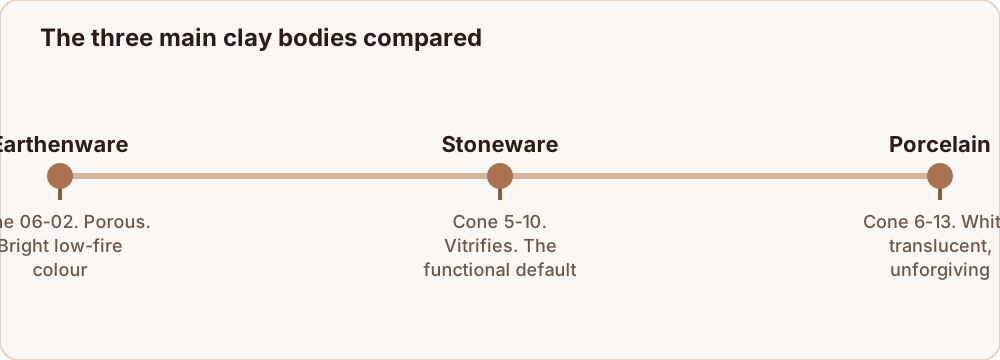
Fires low, roughly cone 06 to cone 02 (1000–1100 °C), and never fully vitrifies. Absorption stays around 5–15%, so an earthenware pot depends on its glaze for water resistance. Terracotta is the familiar red version; white earthenware is the base of most commercial dinnerware.
Good for: bright low-fire colour, majolica, terracotta planters, sculpture, school and community settings with low-temperature kilns. Watch for: crazed glaze lets water into the body, where it can eventually seep, harbour bacteria, or crack the piece with freeze–thaw. Not a good outdoor choice in a frosty climate.
Stoneware
Fires cone 5–10 and vitrifies to under 1–2% absorption. Chunky, forgiving, strong, and the default for functional pottery. Colours run from white and buff through speckled brown, depending on iron content and firing atmosphere.
Good for: essentially everything — mugs, bowls, plates, planters, garden work, sculpture. Watch for: match the body's rated cone to your kiln. Cone 10 stoneware fired to cone 6 is porous and weak.
Grog changes stoneware more than the colour does
Grog is crushed pre-fired clay added back into the body. More grog means:
- lower shrinkage and fewer drying cracks
- better resistance to warping in big or flat pieces
- more tooth, so slabs and coils hold up
- a rougher surface, harder on your hands and on trimming tools
- more open texture, so a thin wall feels less smooth
A fine-grog throwing body is the sweet spot for beginners. A heavily grogged sculpture body is unpleasant on the wheel and excellent for large hand-built work.
Porcelain
Fires cone 6–13, vitrifies hard, and goes translucent when thin. Made from kaolin plus feldspar and silica, with almost no iron, which is where the whiteness comes from.
Good for: white grounds that make glaze colours sing, fine translucent work, crisp forms. Watch for: it is genuinely harder to use. Porcelain has short plasticity (it tears rather than stretches), warps readily, slumps if thrown thin and wet, and shows every drying inconsistency. Modern "porcelaineous stoneware" bodies are a good halfway house.
Specialist bodies worth knowing
- Raku body: heavily grogged, open, built to survive thermal shock from being pulled glowing out of a kiln. Never watertight.
- Paper clay: cellulose fibre mixed into any body. Extraordinary green strength, joins wet to dry, and burns out in the firing. Brilliant for repairs and sculpture.
- Black clay: heavy manganese or iron stain. Handsome, and manganese fumes in the firing warrant good kiln ventilation.
How to actually choose
- What cone can you fire? This eliminates most options immediately. Your kiln or your studio decides for you.
- Functional or sculptural? Functional means you want vitrified — stoneware or porcelain. Sculpture can be anything.
- Wheel or hand built? Wheel wants finer grog and good plasticity. Hand building wants more grog.
- What colour ground do you want under the glaze? White shows colour truly; buff and iron bodies mute and warm it, and speckle through pale glazes.
Test before you commit to a bag pile
Buy one bag. Make a shrinkage test bar: roll a slab, cut a strip, mark exactly 10 cm with a needle, and record the length at bone dry and after glaze firing. That gives you shrinkage percentage — usually 10–14% total — which you need for sizing lids, tiles and anything that has to fit something else.
While you are at it, fire a small unglazed tile to your cone, weigh it, boil it in water for two hours, cool it submerged overnight, dry the surface and reweigh. The percentage gain is your absorption. Under 1% for tableware is what you are looking for, and that one test tells you more about a clay body than any product description.
Two tests worth running on any new body
A clay body's datasheet tells you what the manufacturer measured. These two tests tell you what happens in your kiln, and both take minutes of actual work.
Shrinkage. Roll a slab, cut a strip about 12 cm long, and scribe two lines exactly 10 cm apart with a needle. Measure the distance again when bone dry, and again after the glaze firing. Total shrinkage of 10 to 14 percent is normal. Above that, expect cracking and warping, and consider a more grogged body. You also need this number to size lids, tiles and anything that must fit something else.
Absorption. Fire a small unglazed tile to your cone. Weigh it dry, boil it in water for two hours, leave it submerged overnight to cool, dry the surface and weigh it again. The percentage gain is the absorption: under 1 percent is fully vitrified, around 3 percent is acceptable for most functional work, and 5 percent or more means a porous body that depends entirely on its glaze.
Write both numbers on a card and keep it with the clay. Two minutes of measuring saves you from discovering a body's real behaviour on a piece you cared about.
Where to go next
Your kiln and your cone constrain this choice, so read cone 6 vs cone 10 alongside it. To understand what the grog is actually doing, see what is grog in clay. And when you are ready to buy, where to buy clay for pottery covers what to ask a supplier for.