Grog is clay that has already been fired, crushed back into granules, and mixed into a new clay body. If that sounds circular, it is — and it is one of the oldest tricks in ceramics, used in pots four thousand years older than the potter's wheel.
From the studio: The first time I switched from a smooth throwing body to a grogged hand building one, I hated it. It scratched my fingertips raw in an hour and blunted my favourite trimming tool. Two weeks later I built a slab planter that would have slumped and cracked in the smooth body, and I understood exactly what I had traded for those sore fingers.
What it actually does
Fired clay has been through its chemical changes already. It has no water left to lose, and it will not shrink again. So every particle of grog in a body is a little island that stays exactly the same size while the clay around it dries and shrinks.
That produces four effects, and they all follow from the same fact.
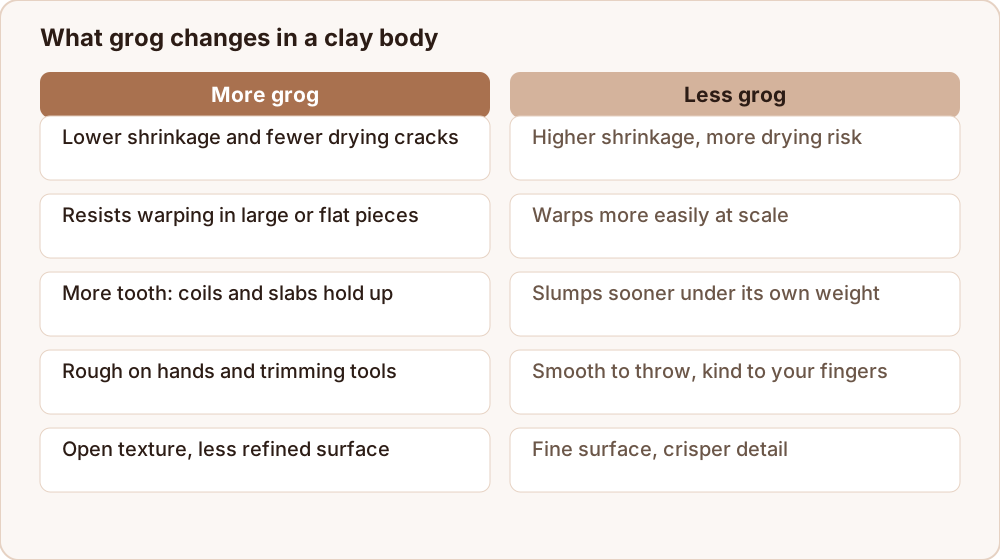
It lowers overall shrinkage. A body with 20 percent grog has 20 percent less material that can shrink. Less shrinkage means less stress, and less stress means fewer cracks.
It opens the body. Grog particles are irregular, so they leave microscopic channels between them. Water from deep inside a thick wall can escape along those channels instead of being trapped, which is exactly what causes thick work to crack or, in the kiln, to blow apart.
It adds tooth. Grogged clay resists slumping. A coil-built wall stands up where a smooth one would sag, which is why hand builders reach for it.
It improves thermal shock resistance. The grog interrupts crack propagation, which is why raku bodies — pulled glowing from a kiln into a bin of sawdust — are always heavily grogged.
What it costs you
Surface. Grogged clay does not take a fine polished surface. Carved detail is less crisp, and a burnished finish is essentially impossible.
Your hands. Grog is abrasive. An hour of throwing a heavily grogged body will genuinely take skin off your fingertips, and long sessions need care.
Your tools. Trimming tools blunt noticeably faster.
Fired strength. Counter-intuitively, a heavily grogged body is often slightly weaker once fired, because the grog interrupts the continuous glassy matrix that forms during vitrification. The green strength goes up; the fired strength comes down slightly.
Particle size matters as much as quantity
Grog is graded by mesh size, and the number tells you a lot:
- Fine grog (around 60–80 mesh) — barely visible, adds working properties without much roughness. Common in throwing bodies.
- Medium grog (around 30–40 mesh) — visible speckle, noticeable tooth. The standard for hand building.
- Coarse grog (20 mesh and larger) — obvious texture, sometimes used deliberately as a surface. Sculpture and large architectural work.
A body with 15 percent fine grog throws almost like a smooth body. A body with 15 percent coarse grog is a completely different material in the hand.
Choosing by what you make
| What you make | Grog content |
|---|---|
| Thrown mugs and bowls | 0–10%, fine |
| Thrown large forms | 10–15%, fine to medium |
| Slab and coil work | 10–25%, medium |
| Large sculpture | 25%+, medium to coarse |
| Raku | High, coarse |
| Porcelain, fine detail | None |
If you are choosing a body from a supplier, this is the second question to answer after the cone — and stoneware, porcelain or earthenware covers the first.
Adding grog yourself
You can wedge grog into a commercial body, or into wild clay that shrinks and cracks too much. It is genuinely useful for processing dug clay, where shrinkage is often the main problem.
The method:
- Weigh out grog at the percentage you want, by dry weight of clay.
- Spread the clay flat and sprinkle the grog over it.
- Fold and wedge thoroughly — at least forty rotations. Grog does not distribute easily.
- Cut the ball with a wire and check the cut face for streaks. Streaks mean keep wedging.
Adding grog is one-way. There is no practical means of getting it back out, so test a small batch before you convert 12 kg of clay.
Alternatives to grog
Sand does a similar job and is far cheaper, but it is pure silica, so it changes the body's thermal expansion and can cause glaze fit problems. Fine for sculpture, riskier under a glaze.
Molochite is a calcined china clay grog. It is white, so it does not speckle a pale body — the usual choice for porcelain and white stoneware.
Paper fibre gives extraordinary green strength and burns out completely in the firing, leaving a lighter, more porous body. It solves different problems from grog and is covered in score and slip joins.
Making your own grog
Studios with a lot of bisque waste sometimes make grog rather than buying it, and it is straightforward if not especially quick.
- Collect bisque-fired scrap — failed pots, test tiles, broken shelves of the same clay body if you have them.
- Break it down. A hammer inside a heavy canvas bag, or a jaw crusher if a studio has one. Wear eye protection; bisque shards travel.
- Sieve to grade it. Separate what passes an 80 mesh from what passes a 30 and what stays behind. The particle size matters as much as the quantity, so unsorted rubble is not grog.
- Wash out the dust. The finest fraction is essentially clay dust and does not behave like grog.
- Wedge it in at your chosen percentage, and test a small batch before converting a whole bag.
Two cautions. Use scrap from the same clay body where you can, since a grog with a different thermal expansion can cause problems under a glaze. And never crush glazed ware — melted glaze fragments in a clay body create bloating and craters that appear only after firing, long after you can do anything about them.
Where to go next
If grog is the thing standing between your hand-built pieces and cracking, the wider picture is in drying pots evenly. To pick a body that already contains the right amount, see stoneware, porcelain or earthenware. And if you are working with clay you dug yourself, how to process wild clay explains when to add it.