Clay is made of clay minerals: microscopically small, plate-shaped crystals of hydrous aluminium silicate. Chemically that means aluminium, silicon, oxygen and water, arranged in layers.
From the studio: Knowing that clay particles are flat plates rather than round grains explained more of my day-to-day problems than any technique video. Shrinkage, plasticity, why compression works, why a dried pot cracks where it does — all of it follows from that one shape.
Most clay you encounter also contains other things — quartz sand, iron oxides, organic matter, calcium compounds — and those extras determine its colour, how hot you can fire it, and how it behaves in your hands.
Where it comes from
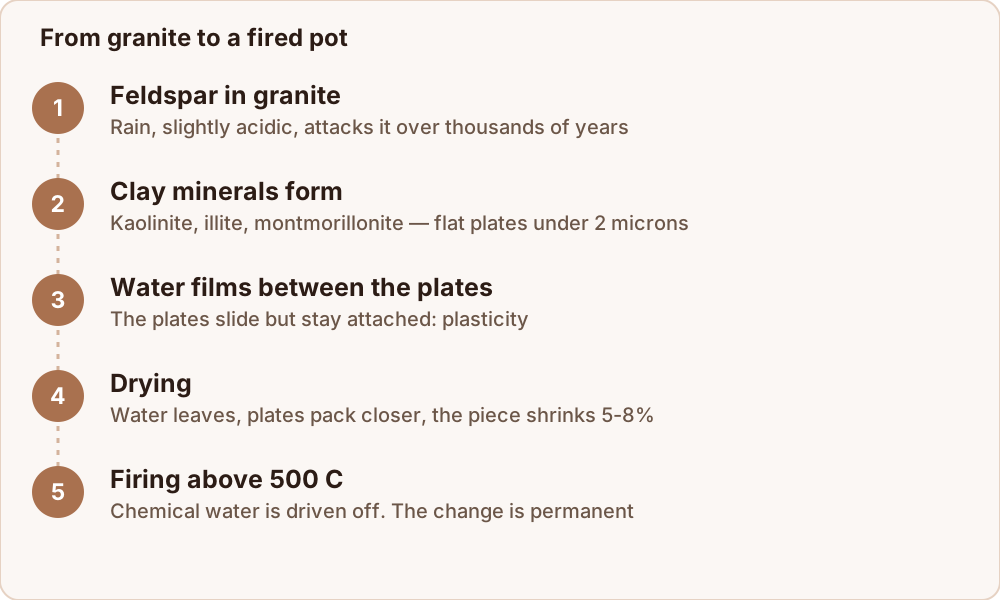
Clay begins as feldspar, one of the most abundant minerals in the earth's crust and a major component of granite. Over very long periods, water, carbon dioxide and temperature cycling break feldspar down, stripping away the soluble sodium and potassium and leaving behind aluminium and silicon bound with water.
That process produces particles smaller than 2 microns across — hundreds of times finer than a grain of sand, and flat rather than round. Everything distinctive about clay follows from that shape and size.
The main clay minerals
Kaolinite — the simplest and purest, Al2Si2O5(OH)4. It is the main mineral in kaolin (china clay) and the basis of porcelain. Low in iron, so it fires white, and relatively non-plastic on its own.
Illite — a mica-derived clay mineral, common in ordinary sedimentary clays. More plastic than kaolinite, contains potassium, and fires at lower temperatures.
Montmorillonite (the main mineral in bentonite) — extremely fine and extremely absorbent. It swells dramatically with water and is added to clay bodies and glazes in small amounts, 1 to 3 percent, to increase plasticity and suspension.
Halloysite and others fill out the family. Almost all natural clay is a mixture rather than a single mineral.
Why clay is plastic
Take a lump of clay, squeeze it, and it holds the new shape. Almost nothing else behaves that way.
The reason is the plates. Clay particles are flat and carry a small electrical charge on their surfaces. Water forms a thin film between them, and that film does two things at once: it lubricates, letting the plates slide past each other, and its surface tension holds them together, so the mass does not fall apart.
Too little water and the plates cannot slide, so the clay is stiff and crumbly. Too much and the films get thick, the attraction weakens, and the clay slumps. Between those extremes is the plastic range — the reason clay can be thrown, coiled, pinched and rolled.
This also explains why clay shrinks. Drying removes the water films and the plates pack closer together, typically shrinking the piece 5 to 8 percent before it even reaches the kiln.
Primary and secondary clay
Primary (residual) clay sits where it formed, still on top of its parent rock. It is pure, coarse-particled, white, and not very plastic. Kaolin is the main example.
Secondary (sedimentary) clay has been carried by water and deposited elsewhere. The journey grinds the particles finer, sorts them, and mixes in iron, organic matter and other minerals. It is far more plastic and usually darker. Ball clay and most common clays are secondary.
Almost every clay body used in pottery blends both, plus non-clay materials.
What else is in a pottery clay body
A commercial clay body is a recipe, not a dug material:
- Clays for plasticity and workability.
- Feldspar as a flux, to lower the temperature at which the body vitrifies.
- Silica (quartz sand) to control shrinkage and thermal expansion, and to help the glaze fit.
- Grog — pre-fired crushed clay — to open the body, cut shrinkage and reduce warping.
- Sometimes talc, bentonite, or paper fibre for particular properties.
That is why a bag of stoneware behaves so much better than clay dug from a ditch. It has been blended for a specific firing range and forming method.
What firing does to it
Heat changes clay permanently and irreversibly.
- Around 100 °C free water evaporates.
- Around 500 °C the chemically bound water is driven out of the mineral structure. This is the point of no return: the clay minerals decompose and can never be dissolved back into slip.
- 573 °C brings quartz inversion, where silica crystals change form and expand suddenly. Fast firing through this range cracks pots.
- Above roughly 1000 °C sintering begins, particles fuse at their contact points, and the material becomes ceramic.
- At the body's maturing temperature, enough glass forms between the particles to close the pores. This is vitrification, and it is what makes stoneware watertight.
Everything on that list is one-way. A clay pot in the ground stays a clay pot for thousands of years, which is why ceramics are the single richest source of evidence in archaeology.
Why the particle shape explains everything else
It is worth pulling the practical consequences together, because almost every property of clay follows from flat particles a couple of microns across.
| Observation | Cause |
|---|---|
| Clay holds a shape when squeezed | Water films let plates slide, surface tension holds them together |
| It shrinks 5–8% as it dries | Water films leave and the plates pack closer |
| Thin walls dry faster than thick ones | Water must travel out through tortuous gaps between plates |
| Compression strengthens a surface | It aligns plates and closes micro-voids that become cracks |
| Grog reduces cracking | Pre-fired particles do not shrink and open escape routes for water |
| Clay soil puddles after rain | Overlapping plates make it nearly impermeable |
| Slip works as glue | The same plates, suspended, fill scored grooves and bond on drying |
| Fired clay never returns | Above 500 °C the mineral structure that held the water is destroyed |
Once that column on the right is familiar, most studio problems stop needing a rule to remember. You can work out what the clay is going to do from what is physically happening inside it, which is a much smaller thing to carry around.
Where to go next
For where the material comes from geologically, read where does clay come from. To turn that theory into a purchase, stoneware, porcelain or earthenware. And is clay renewable or non-renewable covers the resource question this raises.