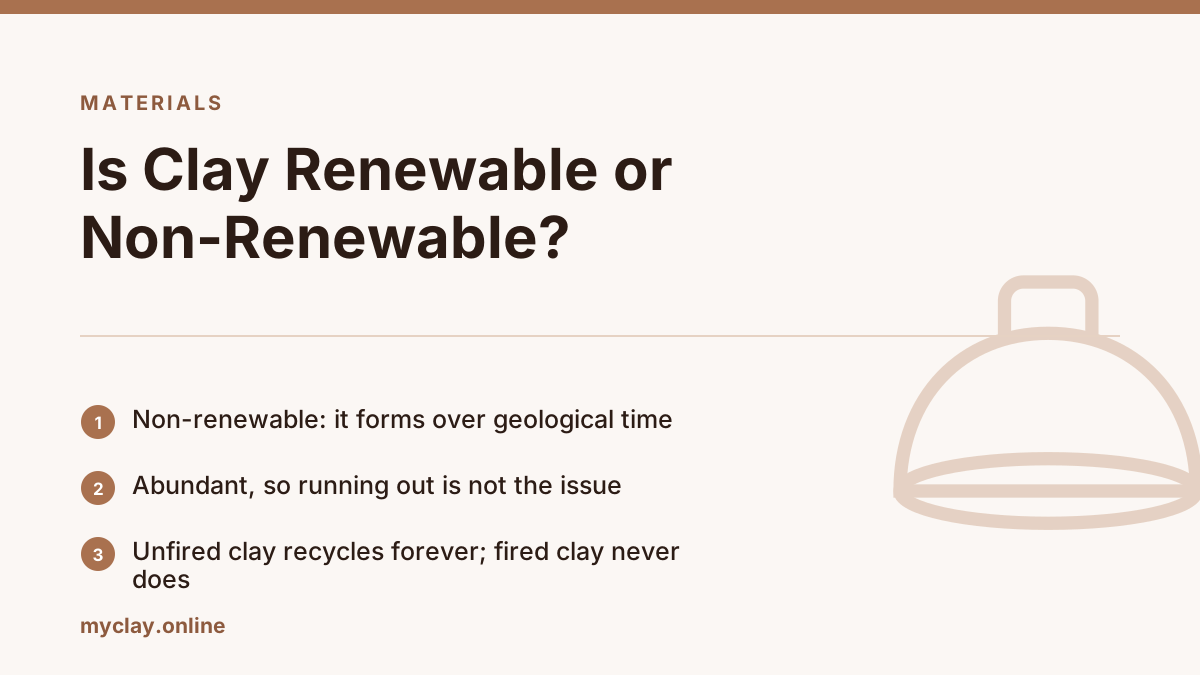
Clay is classified as a non-renewable natural resource. That is the short answer, and it is the one exam boards want. But it is a classification that hides two more interesting facts, and both of them matter if you actually use clay.
From the studio: Running a reclaim bucket properly cut what I actually buy by something close to a third, and the reclaimed clay throws better than the fresh bag because it has been aged and thoroughly mixed. It is the rare case where the environmentally better option is also the nicer material.
Why it is called non-renewable
Clay forms by chemical weathering: rainwater, slightly acidic from dissolved carbon dioxide, slowly breaks down feldspar in rocks like granite. The soluble elements wash away and what remains is hydrous aluminium silicate — clay minerals.
That process takes thousands to millions of years. A commercial quarry removes in a day what took geological time to accumulate.
The definition of renewable hinges on rate, not on whether a process has stopped. Timber is renewable because a forest regrows in decades. Solar energy is renewable because the supply is continuous. Clay, coal, oil, metal ores and stone are non-renewable because replacement happens far slower than use, on any timescale a human institution can plan around.
So clay is still forming, right now, in every riverbank and weathering outcrop on the planet. It simply is not forming fast enough to count.
Why running out is not the concern
Clay minerals make up a very large share of all sedimentary rock and soil on earth. Clay is not scarce in the way that helium or particular rare earth elements are scarce. There is no realistic scenario in which the world exhausts its clay.
What genuinely runs out is a specific deposit with specific properties. A particular kaolin seam with a particular whiteness, particle size and iron content is finite, and when it is worked out, the supplier has to blend something else to approximate it.
Potters see this directly. Clay bodies are periodically reformulated, and named glaze and body ingredients occasionally disappear from catalogues — the mine closed or the seam ran out. The material is abundant; the exact material is not.
Extraction has real costs
Non-renewable does not only mean finite. It also means the extraction has consequences worth acknowledging:
- Land disturbance. Clay is quarried in open pits, which changes landscapes and habitats. Restoration is possible and increasingly required, but it takes decades.
- Energy. The clay itself is cheap. Processing it — washing, filter-pressing, drying — and above all firing it uses substantial energy. For a potter, the kiln is the environmental cost centre, not the clay.
- Transport. Clay is heavy. Moving it across a country or a continent is a large share of both its price and its footprint.
Unfired clay is endlessly recyclable
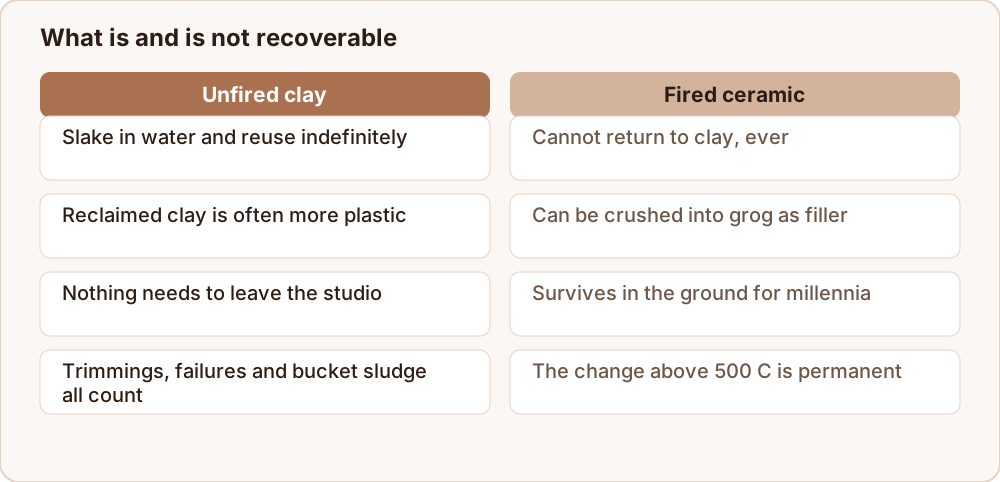
Here is the fact that most matters day to day: before it is fired, clay can be recycled indefinitely.
Trimmings, failed pots, dried scraps, the sludge in your throwing bucket — all of it can be broken up, slaked in water, dried back to workable stiffness on a plaster bat, wedged and used again. The material is not degraded by the cycle. Reclaimed clay is often more plastic than fresh clay, because it has been aged and thoroughly mixed.
In a well-run studio, essentially nothing leaves except plaster and fired ware. That is unusual among craft materials, and it is worth taking advantage of.
Firing is the point of no return
Above roughly 500 °C, the chemically bound water is driven permanently out of the clay mineral structure. The material becomes ceramic and can never be dissolved back into slip.
Fired ceramic can be crushed into grog and added back to a clay body as filler, which is a genuine and useful form of recycling, but it returns as an inert aggregate, not as clay. This irreversibility is why potsherds survive in the ground for thousands of years and why ceramics are the richest artefact class in archaeology.
The honest summary
If you need one sentence for a homework answer: clay is a non-renewable natural resource, because it forms over geological timescales far slower than it is extracted.
If you need the useful version: clay is non-renewable but abundant, its real environmental cost is the energy used to fire it rather than the material itself, and unfired clay is one of the very few craft materials you can recycle forever without loss.
How to run a reclaim bucket
Since the recyclability is the practically useful half of this answer, here is the method in full.
- Keep one bucket per clay body. Mixing bodies gives you an unpredictable blend with an unknown firing range.
- Everything goes in: trimmings, failed pots, dried scraps, and the sludge from the bottom of your throwing water once it has settled.
- Let it dry out completely before adding water. Dry clay slakes down in hours; wet lumps take days and stay lumpy.
- Cover with water and leave it until everything has collapsed into sludge.
- Pour off any standing water from the top.
- Spread it on plaster about 3 cm thick. Turn it over when the top surface stiffens.
- Wedge thoroughly when it holds its shape without sticking to your hands.
The result is often better than fresh clay, because it has been aged and thoroughly mixed. The only thing to watch is contamination — a single piece of plaster in reclaim will cause a fired pot to pop a crater months later, so keep plaster tools well away from the bucket.
Where to go next
For the formation process behind the classification, see where does clay come from. To start reclaiming, the slaking method is in how to make slip for pottery. And how much does pottery clay cost shows what that saves in practice.