Clay in the ground rarely announces itself. It is usually buried under topsoil, and the way to see it is to find somewhere the ground has been cut open — a riverbank, a ditch, a road cutting, a foundation trench.
From the studio: The clue I now trust most is the dry cracking pattern. A dried-out puddle with deep, straight-sided cracks in a polygon pattern has told me there is workable clay underneath every single time, and it is visible from twenty metres away.
In an exposed face
Look at the vertical section rather than the surface. What you are looking for is a band that is smoother and more uniform than everything around it.
- The topsoil layer at the top is dark, crumbly and full of roots.
- Below it, layers separate by particle size: gravelly and sandy bands look speckled and granular.
- A clay band looks solid and even, with no visible individual grains, often with a slight sheen where a spade or the weather has cut it clean.
Clay layers frequently look almost artificially uniform, like a stripe of modelling material laid into the bank. That uniformity is the giveaway.
Colour
Colour comes from what else is present, and covers a wide range:
- Grey and blue-grey — very common, especially in waterlogged deposits where iron is chemically reduced. Often smells faintly of sulphur when freshly dug.
- Orange, red and rust — oxidised iron. Common in well-drained deposits and in terracotta clays.
- Brown — iron plus organic matter.
- Cream, buff and near-white — low iron. Least common in the field and the most useful when you find it.
- Black — high organic content, which burns away in firing to leave a much paler result.
None of these predicts fired colour reliably. Grey clay commonly fires buff or orange, since firing oxidises the iron. Only a test tile tells you.
Texture and behaviour
Wet, clay is sticky, smooth and plastic. It clings to boots and spades in heavy lumps, it feels slightly greasy between the fingers, and it holds any shape you press it into.
Damp, it is dense and cuts cleanly. A spade slices it rather than crumbling it, and the cut face is shiny.
Dry, it is hard, pale and cracks into blocks with distinctly straight edges. Those shrinkage cracks are the most recognisable field sign there is — deep, straight-sided and often forming polygons across a dried pond bed or a bare field.
Three field tests
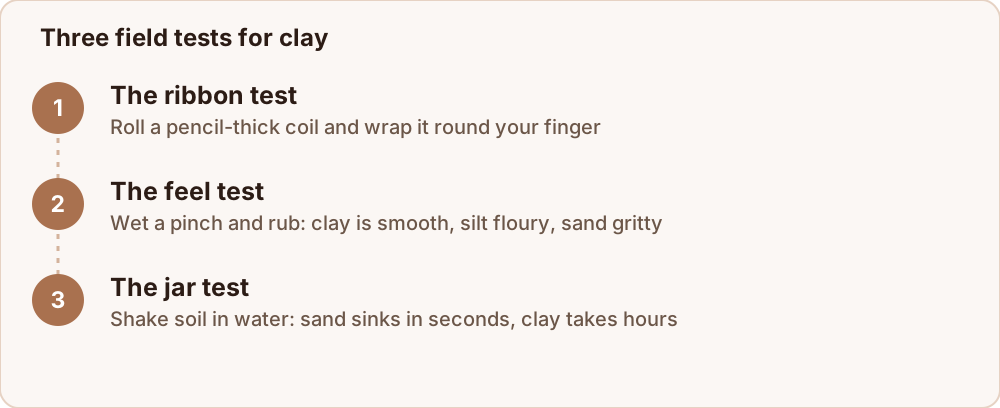
The ribbon test. Wet a lump and roll it into a coil the thickness of a pencil, then wrap it round a finger.
- Wraps with no cracks → high clay content, plastic, usable.
- Bends with a few cracks → some clay, mixed with silt or sand.
- Breaks immediately → mostly silt or sand.
The feel test. Rub a wet pinch between finger and thumb. Clay is smooth with no grit at all. Silt feels floury dry and faintly gritty wet. Sand is unmistakably gritty.
The jar test. Put a few spoonfuls of soil in a jar of water, shake hard, and leave it. Sand sinks in seconds, silt in minutes, clay in hours to days as a distinct top layer. Measure the bands to estimate the proportions.
Where clayey soil shows up
Land that puddles for days after rain, ground that becomes slippery and heavy underfoot, fields that crack in summer, and gardens where a spade meets dense resistance 30 cm down. All of these indicate a clay layer, since compacted clay is nearly impermeable and water sits on top of it rather than draining through.
Ponds that hold water without a liner are sitting on clay. So, usually, are the wettest corners of a garden.
What it looks like once you have it
Freshly dug clay is not ready to use and does not look like the clay in a bag. It contains sand, gravel, roots and organic matter, and it usually needs slaking in water, sieving, settling and drying before it becomes a smooth, uniform, workable body. Judged by eye at the point of digging, good wild clay tends to look disappointingly like heavy mud — which is exactly what it is until it is cleaned.
What it looks like once it is processed
There is a large gap between clay in the ground and clay in a bag, and it catches people out.
Freshly dug clay looks like heavy, wet, unpromising mud, usually with visible sand, small stones, roots and the occasional worm. Nothing about it looks like a material you could make a pot from, and that is normal.
After slaking and sieving, the slurry is smooth and uniform and pours like thick cream. It looks far more like something usable, and it is still much too wet.
Dried back to working stiffness on a plaster bat, it finally resembles bagged clay: dense, even in colour, faintly shiny where it has been cut, and holding a fingerprint cleanly. If it still shows streaks or specks of grit at this point, it needed a finer sieve.
The fired colour is the last surprise. Grey and blue clays commonly fire buff or orange, because the iron in them oxidises in the kiln. Black clays usually fire much paler, since the organic matter that made them dark burns away. Orange clay often stays orange but a few shades duller. There is no shortcut here — only a fired test tile tells you what colour you actually have.
Where to go next
Once you have identified a deposit, where to find natural clay covers digging it responsibly, and how to process wild clay turns it into something you can use. For the garden version, see how to make clay from soil.