Air-dry clay is real clay plus a binder, held together by water. From the moment the packet is opened, water starts leaving — and unlike polymer clay, which never dries, this is a race you are always slightly losing.
From the studio: Spraying a stiff block and using it straight away is the mistake I made for a year. You get a wet skin over a dry core, and everything built from it cracks two days later. Breaking it up and letting it sit in a sealed bag overnight works properly and takes no effort at all.
Good storage is about eliminating air contact, not about adding water.
The method that works
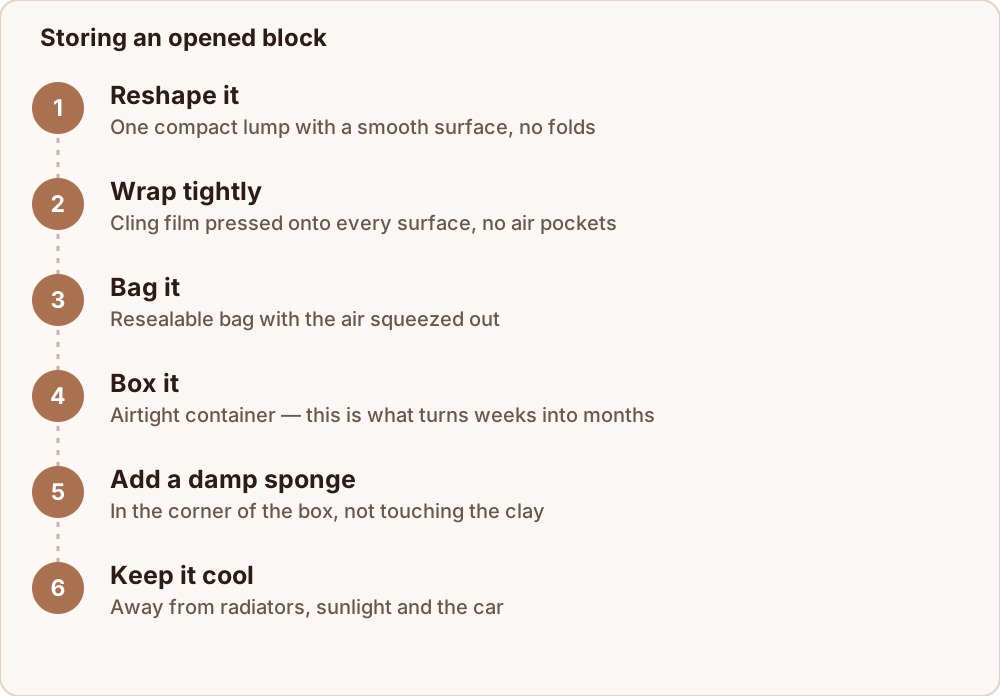
1. Reshape the block. Squash the remaining clay into a single compact lump with no folds or cracks. A ball with a smooth surface has far less exposed area than a torn, ragged offcut.
2. Wrap it tightly. Cling film pressed directly against every surface, or the original plastic packaging if it is intact, taped closed. The enemy is trapped air, so press the wrapping down onto the clay rather than leaving a pocket.
3. Bag it. A resealable freezer bag with the air squeezed out, or a second layer of cling film.
4. Box it. An airtight plastic container with a proper seal. This third layer is what turns "a few weeks" into "several months".
5. Add a damp sponge — not touching the clay. A small damp (not dripping) sponge in the corner of the box keeps the internal air humid. It must not touch the clay, or you will get a soggy patch and a stiff remainder.
6. Keep it cool. A cupboard or a shelf away from radiators and sunlight. Warmth accelerates evaporation through any gap in the wrapping.
Storing work in progress
An unfinished piece is more vulnerable than a block, because it has more surface area and thin sections that dry fastest.
- Cover the whole piece loosely with a plastic bag, or spray a light mist and bag it.
- Wrap thin sections — arms, handles, rims — in individual strips of plastic or foil, so they do not race ahead of the body.
- If you will be away for more than a few days, put the bagged piece inside a box with a damp sponge.
A piece that stiffens unevenly is much harder to work with than one that is uniformly firm, so it is worth the extra minute.
Reviving clay that has stiffened
Slightly stiff but still bendable: wet your hands and wedge it. Repeat a few times. Five minutes usually recovers it.
Firm and cracking: break it into pieces the size of a walnut, put them in a bag, sprinkle water over them, seal, and leave for 24 hours. The water redistributes through the mass. Then wedge thoroughly.
Bone dry and crumbly: break it small, cover with water in a tub, and leave it to slake down for a day. Pour off excess water and spread the sludge on a plaster bat, a board or a stack of newspaper until it stiffens to a workable consistency, then wedge.
Rehydrated air-dry clay is usually a bit less pleasant than fresh — repeated cycles wash out some binder, leaving it short and crumbly. Kneading in a few drops of PVA glue restores much of the working feel and does not affect the finished result.
What not to do
Do not spray a stiff block and use it immediately. You get a wet skin over a dry core, which is exactly the moisture gradient that cracks pieces as they dry.
Do not store it in a paper bag or cardboard box alone. Both draw moisture out of clay.
Do not leave it in the car, on a windowsill or near a radiator. Heat plus any imperfection in the wrapping empties a block quickly.
Do not freeze it. Freezing does not preserve air-dry clay usefully, and thawing leaves the water distributed unevenly through the block.
When a block is genuinely finished
Air-dry clay that has dried and been revived several times eventually loses too much binder to hold together well. You will notice it tearing rather than stretching, and cracking at every bend.
That clay is still useful. Slake it down thin, sieve it, and keep it as a slip for filling cracks and joining pieces — where the lack of plasticity does not matter at all.
Storing tools, slip and work in the same space
Storage problems in air-dry clay rarely stop at the block.
Slip and joining paste. Keep a small sealed jar of slip made from the same clay. It dries out faster than the block because of the surface area, so a screw-top jar rather than a tub is worth it. If it separates, stir it back together; if it grows a skin, sieve it.
Tools. Wipe them before the clay dries on. Dried air-dry clay on a metal tool is harder to remove than pottery clay, because the binder acts like a weak glue.
Unfinished work. Wrap the whole piece loosely and add a strip of plastic over any thin part — handles, arms, rims — so they do not race ahead of the body. A piece that stiffens unevenly is much harder to finish than one that is uniformly firm.
Offcuts. Keep one tub for scraps. When it fills, cover the scraps with water, let them slake down, and dry the sludge back on a board. That reclaim is perfectly usable for interiors, armature filling and repairs, even if it is a little short for detailed work.
Where to go next
If pieces are cracking as they dry, why air-dry clay cracks covers the causes in full. For getting revived clay back to a usable state, see wedging clay properly. And how to harden modelling clay explains sealing once the piece is finished.