In pottery, slip is clay suspended in water. That is all. It ranges from a thick paste to something as runny as milk, and its job changes with its thickness.
From the studio: The moment slip stopped being mysterious for me was noticing the grey film on my own hands after an hour at the wheel. That is slip. It is not a product you buy or a special formula — it is the material you are already covered in.
If you have ever wet your hands while throwing and ended up with a slick grey coating on your fingers, you have made slip by accident. That coating is exactly the material, and it is why the term shows up so often in pottery instructions without ever being properly defined.
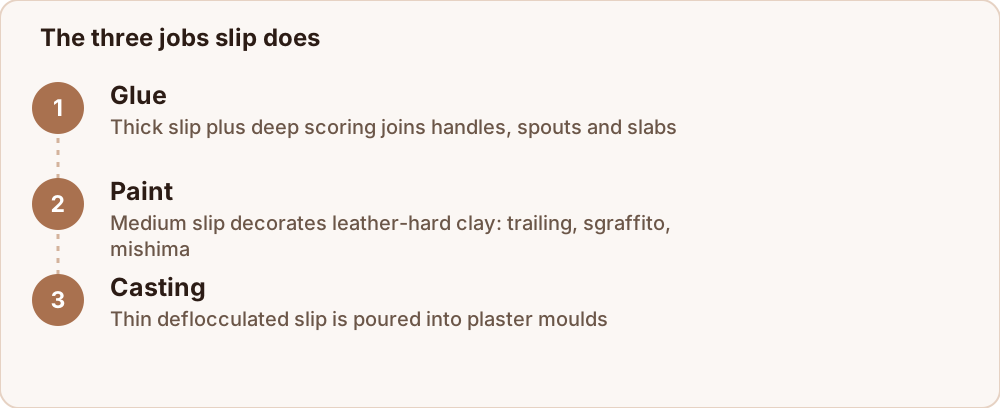
The three jobs slip does
1. Slip as glue
Thick slip is the adhesive that joins one piece of clay to another: a handle to a mug, a spout to a teapot, two slabs into a box.
The full instruction is "score and slip". You crosshatch both surfaces with a needle tool, wet both with slip, and press them together until a bead of clay squeezes out around the seam. The scoring gives the join mechanical grip and surface area; the slip fills those grooves with clay particles.
Slip alone, on smooth unscored clay, is a lubricant. Parts joined that way separate as they dry.
2. Slip as paint
Medium slip, roughly the thickness of single cream, is a decorating material. Because it is clay, it fires to a matt surface in the colour of whatever clay or stain it was made from — a white slip over a red body, a black slip under a clear glaze, coloured slips trailed across a plate.
Slip decoration is applied to leather-hard clay, not to dry clay or bisque. Techniques with names worth knowing:
- Slip trailing — piped from a bottle, like icing a cake.
- Sgraffito — a coat of contrasting slip, scratched through when it has firmed up to reveal the clay beneath.
- Mishima — lines carved into the clay, filled with slip, then scraped flush.
- Marbling and feathering — two wet slips combed together while both are fluid.
3. Slip as a casting material
Thin slip is poured into plaster moulds. The plaster pulls water out of the slip, a layer of clay builds up against the mould wall, and after a few minutes the excess is poured back out, leaving a hollow shell. This is how nearly all identical, mass-produced ceramics are made.
Casting slip is not simply watered-down clay. It contains a deflocculant — a small quantity of sodium silicate or a proprietary equivalent — that makes the clay particles repel each other. That lets the slip pour freely while carrying far less water, which is what keeps castings from warping and cracking.
What slip is not
It is not glaze. Glaze contains a flux that melts it into glass in the kiln. Slip has no flux; it stays a matt clay surface unless you put a glaze over it.
It is not a repair for dry cracks. Slip on bone dry clay shrinks far more than the clay it is sitting on, so a slip-filled crack in dry work usually reopens.
It is not universal glue. It only reliably bonds clay at similar moisture levels — ideally both parts at soft leather-hard.
Making it
Take bone dry scraps of the same clay body, cover them with water, and leave them for a few hours until they collapse. Blend smooth, sieve if you want it fine, and adjust the water until it is as thick as you need. Match the clay body to your piece, since two different bodies shrink by different amounts and will separate at the seam.
Where the word comes from, and where else it appears
The word predates the studio; it comes from Middle English for something thin and semi-liquid, related to slime and slop. In art writing more generally, "slip" almost always still means this liquid clay, and "a slip" as a countable noun means a particular mixture — a white slip, an iron slip, a casting slip.
You may also hear slurry, which is looser and can describe any wet mixture, and magic water, which is water with sodium silicate and soda ash added to make joins tackier. Neither is a different material in any deep sense. It is still clay and water.
Making a small batch in ten minutes
Since most people arrive at this term because an instruction told them to use slip, here is the shortest possible route to having some.
- Collect a handful of bone dry scraps of the same clay you are working in — trimmings, a broken pot, dust from the bottom of the bag.
- Break them small and drop them into a cup or a yoghurt pot.
- Cover with water and leave them. Thumbnail-sized pieces collapse within an hour; larger lumps want overnight.
- Pour off any clear water sitting on top.
- Stir or blend to a thick, smooth cream. A fork works for a small batch.
That is joining slip. For decorating slip, add a little more water and pass it through a kitchen sieve.
Two details that matter more than the method: it must come from the same clay body as the piece, because different bodies shrink differently and separate at the seam. And it keeps indefinitely in a sealed jar — it may develop a smell after a few weeks, which is bacterial and actually improves how it handles.
Where to go next
To actually make some, follow how to make slip for pottery. For its most common use, score and slip joins is the practical post. And if you are trying to work out how slip differs from glaze, what is ceramic glaze made of draws the line clearly.