Glazing is the process of coating a fired clay object with a mixture of minerals and firing it again until that coating melts into a thin layer of glass.
From the studio: It took me embarrassingly long to realise that the porosity of bisque is not a defect to be worked around but the entire mechanism that makes dipping work. Once that clicked, the difference between a pot that takes glaze evenly and one that does not stopped being a mystery.
The word covers the whole activity — choosing the coating, applying it, and the firing that transforms it. The material itself is a glaze. The finished result is sometimes called glost ware or glazeware.
Why it is done
Waterproofing. Most fired clay stays porous. Earthenware in particular absorbs 5 to 15 percent of its weight in water. Glaze is what makes a pot hold coffee rather than seep it.
Hygiene. A porous, unglazed interior is difficult to clean and can harbour bacteria. A glazed one wipes clean.
Durability. Glass is much harder than fired clay, so a glazed surface resists scratching, staining and abrasion.
Appearance. Colour, gloss, texture, depth. For most potters this is the reason, and the other three are welcome side effects.
Where it sits in the process
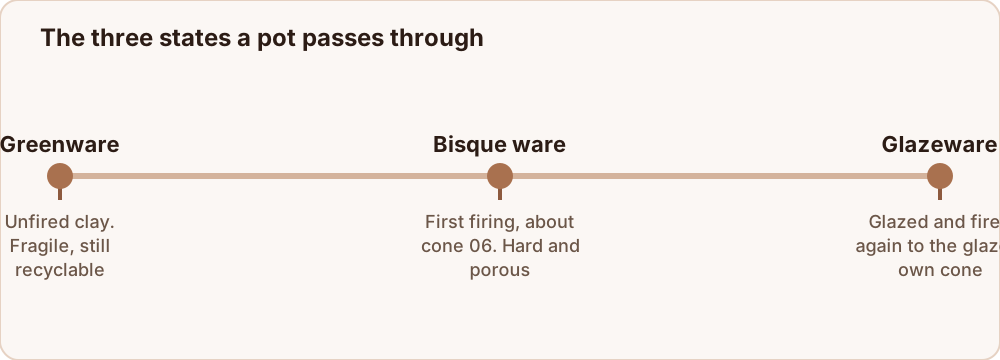
A pot passes through three named states:
- Greenware — unfired clay, from freshly made to bone dry.
- Bisque ware — after the first firing, typically to around cone 06 (about 1000 °C). Hard, still porous, and ready to accept glaze.
- Glazeware — glazed and fired again to the glaze's own maturing temperature.
The porosity of bisque is doing real work. When you dip a bisque pot, it pulls water out of the glaze and leaves an even deposit of glaze material behind. That is why dipping a raw pot fails — it dissolves.
What a glaze is made of
Three components, in every recipe:
- Silica forms the glass.
- A flux lowers silica's melting point from around 1700 °C into kiln range.
- Alumina stiffens the melt so it clings to a vertical wall instead of pooling on the shelf.
Colourants such as iron, cobalt and copper, and opacifiers such as tin oxide, are added on top of that base.
The vocabulary you will meet
Underglaze — colour applied before the glaze, usually on bisque or leather-hard clay. Stays where you put it because it does not melt much. Used for painted detail.
Overglaze — colour or metallic lustre applied on top of an already-fired glaze and fired again at a low temperature. This is where gold and platinum lines come from.
Engobe — a slip adjusted so it behaves more like a glaze, applied to drier clay than plain slip allows.
Clear, opaque, satin, matt — surface descriptions. Clear shows the clay and any decoration beneath; opaque hides it.
Celadon, shino, tenmoku, ash — traditional glaze families, mostly high-fire, defined by their chemistry and their firing atmosphere.
Crazing — a fine crack network in the glaze from a thermal expansion mismatch. Decorative on some ware, a genuine hygiene problem on functional pieces.
Food safe — a property of the fired result, not a glaze type. It depends on the glaze being fully melted, properly fitted to the body without crazing, and free of leachable metals in the surface.
How it is applied
Dipping — submerging the pot in a bucket. Fastest and most even, and how most production work is glazed.
Pouring — filling and emptying the interior, and pouring over the exterior. Used for pieces too large to dip.
Brushing — three coats of a gum-containing brushing glaze, each in a different direction. Best for detail and for small quantities.
Spraying — in a booth with extraction. Gives gradients and blends, and needs proper equipment because airborne glaze is exactly what you must not breathe.
Whatever the method, the target thickness is about that of a postcard, and every surface that touches the kiln shelf must be wiped back to bare clay.
What glazing is not
It is not a sealant you apply and leave to dry — without a firing, a glaze coat is chalky powder that brushes off.
It is not a repair. A crack in a pot will still be a crack under glaze, usually a more visible one, because glaze pools in it.
And it is not one-size-fits-all. Every glaze is formulated for a specific temperature range. Firing a cone 6 glaze at cone 10 makes it run off the pot; firing it at cone 04 leaves an unmelted crust. The cone rating matters more than anything else on the label.
The questions this usually leads to
Three follow-ups come up almost every time, and short answers help.
Why does the pot need firing twice? It does not, strictly — single firing exists and works. But bisque firing makes the pot hard enough to handle and porous enough to absorb glaze evenly, which makes glazing far easier and far more forgiving. The two-firing sequence is a practical convenience, not a physical necessity.
Why can I not glaze the bottom? Because molten glaze is glass, and glass sticks to whatever it touches. Any glaze on the foot fuses the pot permanently to the kiln shelf, and separating them damages both. Wipe every surface that touches the shelf back to bare clay.
Why did my glaze look different from the sample? Because a fired glaze depends on the clay underneath it, the thickness applied, the firing schedule and the cooling rate. The same glaze on a white body and a dark body can look like two different products, and a slow cool can turn a gloss into a satin.
All three lead to the same habit: test on your own clay, in your own kiln, before committing a batch of work.
Where to go next
For what a glaze is actually made from, read what is ceramic glaze made of. For the practical steps, how to glaze pottery at home. And to understand where bisque sits in the sequence, see the stages of clay.