In sculpture, a clay model is the original three-dimensional work the artist makes by hand in clay. It is the source object. Everything else — the mould, the bronze, the resin, the marble carved to its proportions — descends from it.
From the studio: What surprised me most is how much of the sculptor's hand survives the translation. Fingerprints and tool marks in the clay come through in the bronze, which is why casts from clay originals look so different from machined or carved work.
The term covers a range of sizes and stages, and the distinctions matter in practice.
The terms
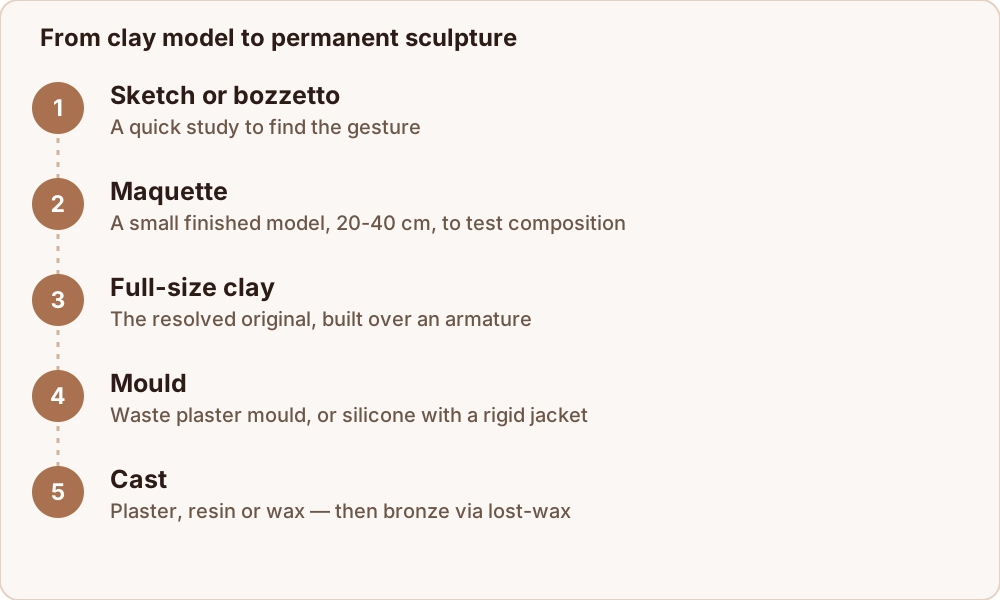
Sketch or bozzetto — a very quick, small study, made in minutes to find a gesture or a composition. Often deliberately rough.
Maquette — a small finished model, typically 20 to 40 cm, made to test composition, proportion and silhouette before the full-size work. Presented to clients and committees to approve a design, and frequently a valued work in its own right.
Full-size clay — the finished original at final scale. This is the piece the sculptor actually resolves, and it is what gets moulded.
Armature — the internal skeleton of wood, metal pipe or wire that holds the clay up. For anything above small scale, the armature is engineering, not an afterthought: clay is heavy and will collapse under its own weight.
Why clay
Clay is the only common sculptural material that is truly additive and subtractive at once. You can build up, cut back, and rework the same passage twenty times. Stone carving is one-way; welding is slow; casting cannot be done directly by hand.
Clay also holds the sculptor's touch. Fingerprints, tool marks and the pace of the modelling survive into the final bronze, which is why casts from clay originals look different from carved or machined work.
And it is cheap enough to experiment with, and — in the oil-based version professionals use — endlessly reusable.
Which clay
Oil-based clay (Monster Clay, Chavant, Plastilina) is the professional standard for anything that will be cast. It never dries, so a piece can be worked over months, and it is fully recoverable afterwards. Its softness is controlled with heat.
Water-based ceramic clay is used where the clay original will itself be fired, and in academic study where the tradition runs that way. It must be kept damp under plastic between sessions and hollowed before firing.
Wax substitutes for small work destined for lost-wax metal casting.
From clay to permanent material
The clay model is not the finished sculpture. Clay is fragile, and unfired clay is not durable at all. The route to permanence is moulding and casting:
- Mould the clay. Traditionally, a waste mould of plaster is built over the clay, then broken away — destroying both mould and, usually, the clay original. Modern practice uses silicone rubber backed by a rigid plaster or fibreglass jacket, which survives and can produce multiple casts.
- Cast from the mould. Plaster for study casts and exhibition pieces, resin for props and editions, or wax for the lost-wax process.
- For bronze, the wax cast is chased by hand, invested in a ceramic shell, burned out, and filled with molten bronze. The bronze is then cut from its casting channels, welded together if cast in sections, chased and patinated.
Each step is a translation, and the sculptor's decisions in clay survive all of them.
Pointing: clay to stone
Marble and stone sculpture also start in clay. A pointing machine — a mechanical measuring frame — transfers measurements from the clay or plaster model to a stone block, so the carver can remove material to precisely the right depth at hundreds of reference points.
This is why a carved marble portrait can match a clay model exactly. The clay is still the original; the stone is a copy made by removal rather than by pouring.
Beyond fine art
The same principle runs through industry. Car manufacturers still sculpt full-size clay models of new vehicles over a foam and steel armature, because a physical surface reveals reflections, proportion and stance in a way a screen render does not. Animation studios sculpt character maquettes for reference. Product designers model in clay before committing to CAD.
In each case the logic is the same as the sculptor's: clay is the fastest way for a hand to find a three-dimensional form, and everything permanent is made from what the hand found.
Why the clay original is usually destroyed
This surprises people, so it is worth explaining properly.
The traditional method is a waste mould. Plaster is built up over the finished clay in a shell, usually with a coloured first layer so the sculptor knows when they are getting close to the surface during removal. The clay is dug out, the mould is cast in plaster, and then the mould is chipped away from the cast — destroying itself in the process. One mould, one cast, and the clay is gone.
That sounds wasteful until you consider what it buys: extraordinarily faithful surface detail, no seam lines from a flexible mould, and no need for expensive rubber.
Silicone moulding changed this. A flexible rubber mould pulls off undercuts without destroying either the mould or the original, and it can produce an edition of casts. It is now standard for anything being reproduced more than once.
Either way, the clay itself is rarely kept. Oil-based clay is scraped out, remelted and used for the next piece — a sculptor might work through the same block for years. The clay was never the artwork; it was the means of arriving at it.
Where to go next
For the working method behind the model, read how to sculpt with clay. To choose the material, what clay is best for sculpting. And how to use Monster Clay covers the oil clay that most of this work is made in.